


Subtotal $0.00

You grab your phone to check one notification. Minutes later, you are reading one worrying headline after the other … bad news, conflicts, health scares, disasters, financial uncertainty and upsetting social media posts.
Before you realize it, 30 minutes have passed.
You put your phone down, but instead of feeling informed, you feel tense, restless or emotionally exhausted. This habit is commonly known as doomscrolling.
The connection between doomscrolling and mental health deserves attention because digital platforms have become a constant part of everyday life. Staying informed can be useful, but repeatedly consuming distressing content may increase worry, disturb sleep, affect concentration and make it difficult for the mind to relax.
The problem is not simply “using your phone too much.” What you consume, how often you check it, why you keep scrolling and how the content makes you feel all matter.
For someone already dealing with stress or anxiety, the endless stream of negative information can become especially overwhelming.
At Dr. Mehraaj Sandhu’s practice, mental well-being is approached by looking at the complete picture—including emotional patterns, daily routines, sleep, stress, relationships and digital habits.
Understanding why doomscrolling happens is the first step toward creating a healthier relationship with social media.
What Is Doomscrolling?
Doomscrolling refers to repeatedly scrolling through negative, alarming or distressing online content, even when doing so makes you feel worse.
It often happens automatically.
A person may begin by checking the news or social media for a few minutes and then continue reading upsetting updates for much longer than intended.
Why Is It So Hard to Stop Scrolling?
Humans naturally pay attention to possible threats. In the past, being alert to danger helped people survive.
Today, the same tendency can make negative headlines difficult to ignore.
You may think:
- “What happened next?”
- “Is there another update?”
- “Could this happen to me?”
- “What if things get worse?”
Each new post creates another reason to continue.
Social platforms also make content easy to consume continuously. Infinite feeds, notifications, recommendations and constantly updated information can remove the natural stopping points that once existed when reading a newspaper or watching scheduled news.
The result can be a cycle of checking, worrying and checking again.
Understanding Doomscrolling Anxiety
“Reading one upsetting story does not create an anxiety disorder. But repeated exposure to upsetting information may leave some people in a more worried state.
The mind may start to feel like threat is an ever-present thing—even when the person is physically safe.
Your Brain May Stay in an Alert State
When you encounter threatening information, your body can activate its stress response.
You may notice:
- Faster heartbeat
- Muscle tension
- Restlessness
- Difficulty relaxing
- Racing thoughts
- Increased worry
If you continue consuming stressful content, your mind may have little opportunity to recover.
This can create doomscrolling anxiety, where checking the phone temporarily feels necessary but the information you find increases your distress.
Over time, the habit may make uncertainty harder to tolerate.
Effects of Social Media on Mental Health
Social media itself is not automatically harmful. It can help people communicate, learn, build communities, discover opportunities and maintain relationships.
The impact often depends on how it is used.
Problems may develop when social media becomes compulsive, interferes with daily responsibilities, encourages constant comparison or repeatedly exposes someone to emotionally distressing content.
Too Much Negative Content Can Affect Your Mood
Repeated exposure to disturbing stories may change how you perceive the world around you.
You may begin to feel:
- The world is constantly unsafe
- Something bad is about to happen
- You need to keep checking for updates
- You are powerless to change anything
These thoughts can increase emotional exhaustion.
The effects of social media on mental health can also vary significantly between individuals. Someone experiencing existing anxiety, depression, loneliness or major life stress may respond differently from someone using social media casually.
This is why personal patterns matter more than screen time alone.
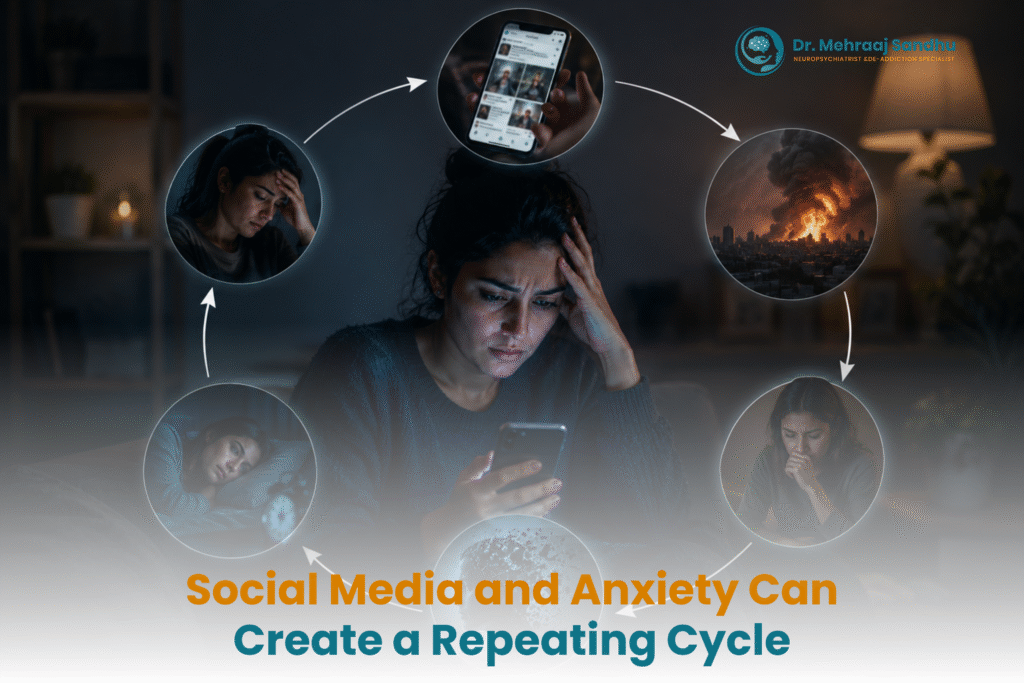
Social Media and Anxiety Can Create a Repeating Cycle
People who are anxious often want certainty.
In times of uncertainty, looking to social media or the news can provide you with some relief for the moment. Sorry, but another disturbing post can easily create a new worry.
The cycle may look like this:
Worry → Check phone → Find upsetting information → Feel more anxious → Check again
Reassurance-Seeking Can Become a Habit
Imagine you are worried about a health issue.
You search for information online and initially feel reassured. Then you encounter a frightening story about a rare condition.
You search again.
Soon, instead of feeling calmer, you have dozens of new concerns.
A similar pattern can occur with financial news, relationships, world events, safety concerns or other uncertainties.
Recognizing this cycle is important because the solution is not necessarily to find more information. Sometimes the healthier response is to recognize when you already have enough.
Negative Effects of Doomscrolling on Everyday Life
The impact of excessive negative scrolling may continue even after you put your phone away.
Your thoughts, sleep, attention and emotional state can all be affected.
Increased Stress and Emotional Exhaustion
Constant exposure to upsetting information can make the mind feel overloaded.
Some people notice:
- Irritability
- Persistent worrying
- Mental fatigue
- Difficulty concentrating
- Feeling helpless
- Reduced motivation
This emotional overload can make ordinary daily challenges feel more difficult to manage.
Difficulty Focusing on Work or Studies
Doomscrolling repeatedly interrupts attention.
You may check one notification while working and then spend several minutes moving between posts, videos, comments and headlines.
Returning to the original task can take additional mental effort.
Over time, frequent interruptions may affect productivity and make sustained concentration more difficult.
Doomscrolling Can Disrupt Healthy Sleep
Bedtime is one of the most common times for excessive scrolling.
The room is quiet, responsibilities have slowed down and your phone is easily accessible. What begins as a quick check can turn into an hour of consuming stimulating or worrying information.
Why Night-Time Scrolling Keeps Your Mind Active
Disturbing content can trigger thoughts that continue after the screen is turned off.
Instead of relaxing, you may lie awake thinking about:
- News events
- Health concerns
- Work problems
- Other people’s lives
- Financial worries
- Future uncertainties
Late-night phone use may also delay bedtime simply because scrolling continues longer than planned.
Poor sleep can then make emotional regulation more difficult the following day, potentially increasing irritability and anxiety.
This can create another cycle:
Scrolling → Later or poorer sleep → Fatigue → Lower emotional resilience → More stress → More scrolling
Social Comparison Can Make Anxiety Worse
Not all harmful scrolling involves bad news.
Social media also presents highly selected versions of other people’s lives—successful careers, holidays, relationships, fitness achievements, homes and personal milestones.
When you compare everyday reality with someone else’s carefully selected highlights, your own life may seem inadequate.
The Comparison Trap
You may begin thinking:
- “Everyone is doing better than me.”
- “I’m falling behind.”
- “Why isn’t my life like that?”
- “I should have achieved more by now.”
These comparisons may contribute to dissatisfaction, low self-esteem, or anxiety.
It is important to remember that online content rarely shows a complete life. People usually share selected moments, not every struggle, disappointment or ordinary day.
Social Media Addiction and Mental Health
Not everyone who spends a lot of time online is addicted. However, digital habits can become problematic if the person feels unable to control them, even if there are negative consequences.
The main question is not just “how many hours do I spend on my phone?
A better question is “How is this affecting my life?
Signs Your Social Media Use May Be Becoming Unhealthy
Pay attention if you:
- Check your phone automatically every few minutes
- Feel anxious when you cannot access social media
- Lose track of time while scrolling
- Stay online despite feeling emotionally worse
- Delay sleep because of social media
- Ignore work, studies or relationships
- Repeatedly try to reduce usage but struggle
The relationship between social media addiction and mental health can be complex. Anxiety may drive excessive use, while unhealthy use may also worsen emotional distress.
Professional assessment can help identify what is driving the behaviour.
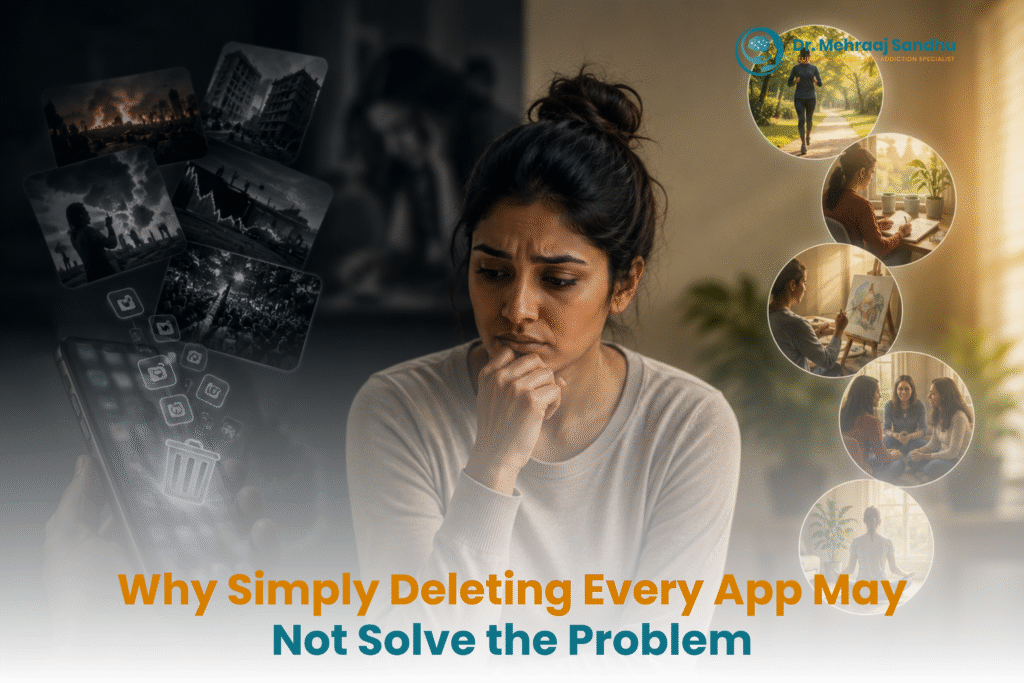
Why Simply Deleting Every App May Not Solve the Problem
Deleting social media can help some people, but it is not the only solution.
If scrolling has become a way to cope with boredom, loneliness, anxiety or stress, removing an app without addressing the underlying trigger may lead to another repetitive behaviour.
Understand What Makes You Reach for Your Phone
Before opening an app, ask yourself:
“Why am I checking right now?”
Possible answers might include:
- I am bored.
- I feel anxious.
- I am avoiding a difficult task.
- I feel lonely.
- I want reassurance.
- I am checking automatically.
Identifying the trigger helps you choose a healthier response.
For example, boredom may be better addressed with a walk or hobby, while anxiety may require relaxation techniques, emotional support or professional care.
How to Stop Doomscrolling Without Avoiding the Internet
You do not have to disconnect completely to develop healthier digital habits.
The goal is to use technology intentionally rather than automatically.
Create Clear Boundaries Around News and Social Media
Try practical changes such as:
- Choose specific times to check the news.
- Turn off unnecessary notifications.
- Avoid keeping your phone beside your bed.
- Unfollow accounts that repeatedly increase distress.
- Take regular screen-free breaks.
- Avoid checking upsetting content immediately after waking.
- Create a no-phone period before bedtime.
Learning how to stop doomscrolling is often easier when you change your environment rather than relying only on willpower.
If your phone constantly sends alerts, resisting every notification requires repeated effort. Reducing those triggers makes healthier behaviour easier.
Replace Scrolling With Something Meaningful
Stopping a habit creates empty time.
If you do not decide what to do with that time, you may quickly return to the same behaviour.
Build Healthier Alternatives
Instead of automatically scrolling, consider:
- Going for a short walk
- Reading a book
- Listening to music
- Calling a friend
- Exercising
- Practicing deep breathing
- Journaling
- Spending time outdoors
The replacement does not need to be highly productive.
Sometimes simply sitting quietly with a cup of tea is more restorative than consuming another 50 pieces of information.
The goal is to give your brain moments when it does not need to process constant stimulation.
Curate Your Digital Environment
You have more control over your feed than it may initially seem.
Your online environment can influence what receives your attention every day.
Make Your Feed Work for Your Well-Being
Review the accounts and sources you follow.
Ask:
- Does this account educate me?
- Does it inspire me realistically?
- Does it repeatedly make me anxious?
- Do I trust this source?
- Am I following it because it adds value or simply out of habit?
Mute, unfollow or limit content that consistently harms your emotional well-being.
For important news, consider relying on a few credible sources rather than repeatedly refreshing multiple platforms throughout the day.
Practice a Simple Digital Reset
You do not necessarily need a dramatic “digital detox.”
Small, sustainable changes may be easier to maintain.
Try a 7-Day Healthier Scrolling Experiment
For one week:
- Do not check social media for the first 30 minutes after waking.
- Keep meals screen-free when possible.
- Set specific news-checking times.
- Turn off non-essential notifications.
- Keep your phone away during focused work.
- Stop scrolling at least 30 minutes before bedtime.
- Notice how your mood changes.
The purpose is not to prove that phones are bad.
It is to discover whether your digital habits are supporting or draining your mental well-being.
When Should You Seek Professional Help?
Occasional worry after reading disturbing news is a normal emotional response.
However, professional support may be helpful when anxiety becomes persistent or begins interfering with everyday life.
Signs You May Need Mental Health Support
Consider speaking with a qualified mental health professional if you experience:
- Persistent anxiety that feels difficult to control
- Frequent panic symptoms
- Ongoing sleep problems
- Significant difficulty concentrating
- Loss of interest in normal activities
- Social withdrawal
- Compulsive checking that you cannot reduce
- Distress that affects work, studies or relationships
You do not need to wait until symptoms become severe before asking for help.
Early support can help you understand your triggers and develop healthier coping strategies.
How Dr. Mehraaj Sandhu Can Help
Maybe scrolling problems are not the whole problem but a symptom of a deeper problem…
Emotional concerns like anxiety, depression, chronic stress, loneliness or sleep difficulties may affect how one uses digital platforms.
Treating the Person, Not Just the Screen Habit
At Dr. Mehraaj Sandhu’s practice, mental health care focuses on understanding the individual’s complete experience rather than simply telling someone to “use their phone less.”
A professional assessment can explore:
- Anxiety patterns
- Sleep difficulties
- Stress triggers
- Mood changes
- Compulsive behaviours
- Daily routines
- The impact of digital habits
Depending on individual needs, treatment may include psychological strategies, lifestyle changes, therapy or other appropriate interventions.
The aim is to help individuals build sustainable coping skills and a healthier relationship with both technology and their emotional well-being.
Frequently Asked Questions (FAQs)
Q1. What does doomscrolling mean?
Doomscrolling means repeatedly consuming negative or distressing online content, often for longer than intended, even when it increases stress or makes you feel emotionally worse.
Q2. Can doomscrolling increase anxiety?
It can contribute to anxiety in some people by repeatedly exposing the mind to threatening information and encouraging constant checking, worry and difficulty switching off.
Q3. Why do I keep scrolling even when it makes me anxious?
Negative information can capture attention, while continuous feeds encourage repeated checking. Some people also scroll to seek reassurance or cope with boredom, stress or uncertainty.
Q4. Can doomscrolling affect sleep?
Yes. Late-night scrolling can delay bedtime and keep the mind mentally stimulated, particularly when the content is upsetting or emotionally intense.
Q5. Should I completely stop using social media?
Not necessarily. Setting boundaries, limiting notifications, curating your feed and using social media intentionally may be more practical than completely avoiding digital platforms.
Q6. When should I seek help for social media-related anxiety?
Consider professional support if anxiety, compulsive checking, poor sleep or mood changes persist and begin affecting your work, relationships, studies or daily functioning.
Q7. How can Dr. Mehraaj Sandhu help?
Dr. Mehraaj Sandhu can assess underlying anxiety, stress, sleep or mood concerns and recommend an individualized, evidence-based approach to improving mental well-being and unhealthy digital habits.
Conclusion
Social media provides us with instant access to information, communities and people across the globe. But just because we can be constantly connected doesn’t mean we have to consume every update.
When scrolling repeatedly increases anxiety, disturbs sleep, impacts concentration or leaves you feeling emotionally depleted, the link between doomscrolling and mental health becomes a concern.
It’s not about being afraid of technology or deleting every social media account.
Instead start by noticing your patterns.
Ask yourself why you are checking your phone, how you feel afterward and whether the information you consume is genuinely helping you.
Simple boundaries—such as limiting notifications, avoiding late-night scrolling, choosing trusted information sources and creating screen-free periods—can help you regain control over your attention.
If digital habits are connected with persistent anxiety, low mood, sleep problems or compulsive behaviour, professional support can help address the underlying cause.
At Dr. Mehraaj Sandhu’s practice, the focus is on understanding each person’s individual mental health needs and developing practical, evidence-based strategies for long-term emotional well-being.
Your phone is a tool. It should help you stay connected and informed—not keep your mind trapped in a constant cycle of fear and worry.
Medical Disclaimer:
This article is for general educational purposes only and is not a substitute for professional mental health advice, diagnosis or treatment. If anxiety or other symptoms are affecting your daily life, consult a qualified mental health professional.

MediCompares
July 29, 2026Excellent and highly informative blog, Dr. Mehraaj Sandhu! 👏 Thank you for explaining the connection between doomscrolling and mental health in such a clear, practical, and compassionate way. Your insights into anxiety, stress, sleep, social media habits, and emotional well-being are extremely relevant in today's fast-paced digital world. Blood test Hyderabad